

At Ardal, we recognise that our suppliers are at different stages in their carbon reduction journey. We’ve created this dedicated space to support you in cutting emissions, no matter where you are on your journey.
Here, you’ll find tools, guidance, and useful resources available online that are designed to help suppliers understand, measure, and reduce their carbon footprint.
How to Begin Your Carbon Journey
Reducing your carbon footprint starts with understanding it. This page will walk you through the key steps—from identifying the data you need, to calculating your emissions, and creating a Carbon Reduction Plan.
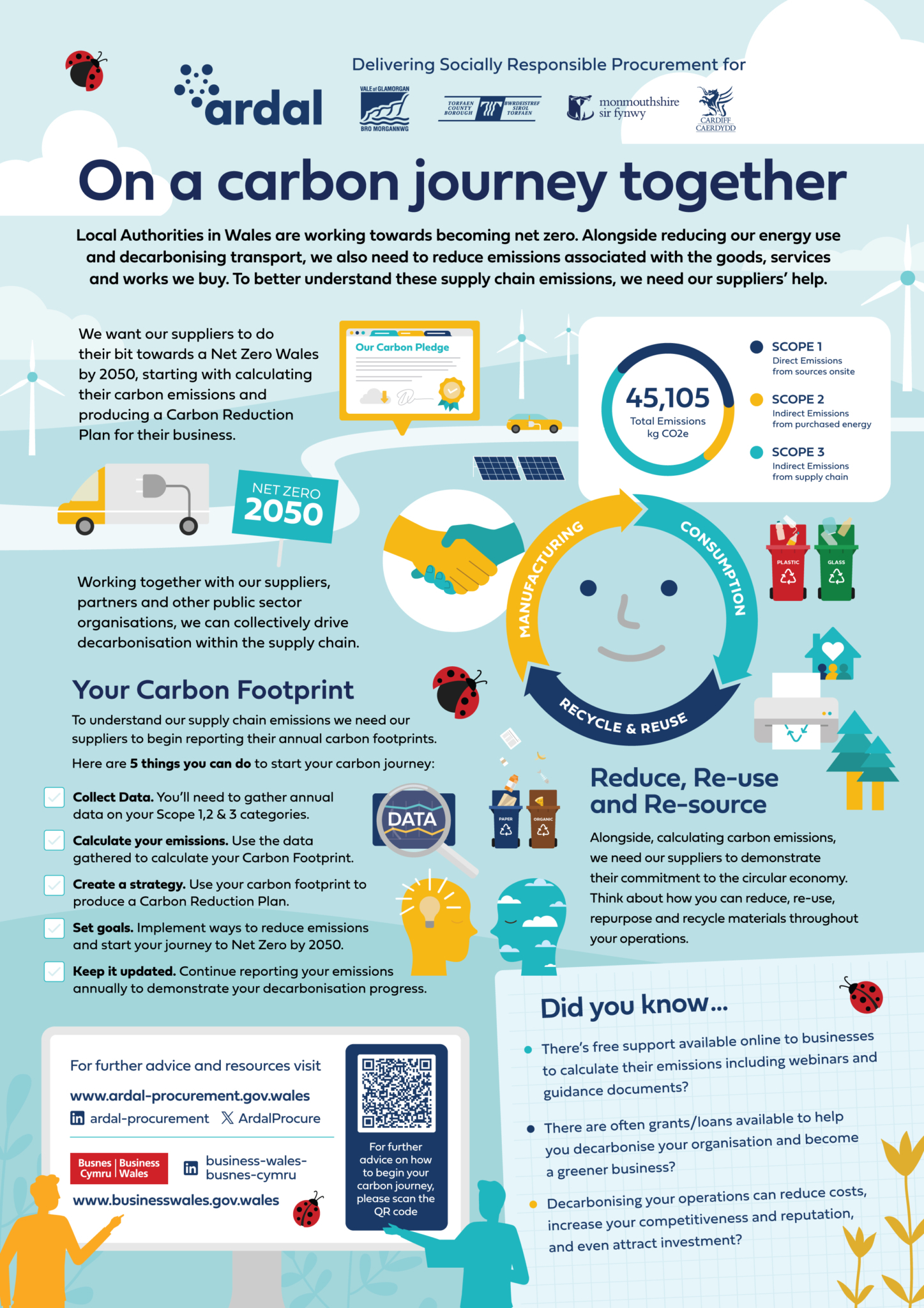
Ardal have launched a new infographic designed to help suppliers kick‑start their decarbonisation journey.
📲 Before you begin, take a moment to explore the infographic!
Step 1: Understand What You Need to Measure
Before you can begin reducing your emissions, it's important to understand what data you’ll need to gather across your business in order to calculate your Carbon Footprint. To calculate it accurately, you'll need to collect data across three categories of emission sources, as defined by the Greenhouse Gas (GHG) Protocol:
Scope 1 – Direct Emissions
These are emissions from sources your organisation owns or controls directly.
You’ll need data on:
- Fuel used in company vehicles (e.g petrol or diesel consumption)
- On-site fuel used to generate heating (e.g. gas consumption for boilers)
- Refrigerant use and leakage (e.g. refrigerant leaked and replaced from air conditioning units)
- Fuel used for industrial processes onsite (if applicable)
Scope 2 – Indirect Emissions from Purchased Energy
These are emissions from the electricity, steam, heat or cooling you purchase and use. This energy must be generated off-site.
You’ll need data on:
- Electricity usage (e.g. for use in buildings and charging electric vehicles)
- Purchased heating or cooling (e.g. district heating)
Scope 3 – Other Indirect Emissions
These are emissions from your wider value chain and supply chain, including both upstream and downstream activities.
*Please note that there are fifteen categories of emission sources within Scope 3 that a business can report on. However, to produce a carbon reduction plan you just need to begin with the following five.*
You’ll need data on:
- Upstream Transportation & Distribution (e.g. Supplier Deliveries)
- Downstream Transportation & Distribution (e.g. Courier services to deliver sold products to customers)
- Waste generated in operations (e.g. third-party disposal and treatment of waste)
- Business travel (e.g. transport of employees for business-related activities in third party vehicles)
- Employee commuting (e.g. transport of employees between homes and their workplace)
Whilst not required currently within Carbon Reduction Plans, we encourage businesses to report on their Purchased Goods & Services, as your supply chain often represents a large percentage of an organisation’s emissions. To report this data, organisations are advised to record their expenditure with suppliers.
Remember, Scope 3 can be complex, but even partial data collection helps build a clearer picture of your organisation’s emissions.
Helpful Reading:
Check out the GHG Protocol Corporate Standard for guidance on accurate reporting.
Step 2: Use a Carbon Calculator
Once you’ve gathered your data, you can calculate your carbon footprint using one of these tools or any other trusted carbon calculator available online:
- SME Climate Hub Calculators – Designed for small businesses, covering all three scopes.
- Business Wales Carbon Calculator – Support and Carbon Calculator for Welsh businesses.
Step 3: Create Your Carbon Reduction Plan (CRP)
Once you know your footprint, it’s time to plan how to reduce it.
📌 Important: If you're bidding for public contracts over £5 million (excl. VAT), you will be required to submit a compliant Carbon Reduction Plan in accordance with the WPPN 06/21.
Your CRP should include:
- A net zero commitment (by 2050 or earlier).
- Baseline emissions (including a breakdown of Scope 1-3 emissions).
- Interim targets and actions to reduce emissions.
- Annual updates and public visibility
- Declaration and sign off by a senior executive (including their name, job title and date)
✅ To meet the technical standard your CRP must be published clearly on your website.
Resources to Help You Create a CRP
For guidance on how to produce a compliant Carbon Reduction Plan, use the resources listed below:
- GCA Template – Government Commercial Agency
- Carbon Reduction Plan Training – Eventbrite
- Technical Standard for Completion of Carbon Reduction Plans – GOV.UK
